B.Sc. Thesis (Grade A) | CTU in Prague | Supervisor: Jiří Zemánek | Laboratory: Department of Control Engineering
Project Overview & Objective
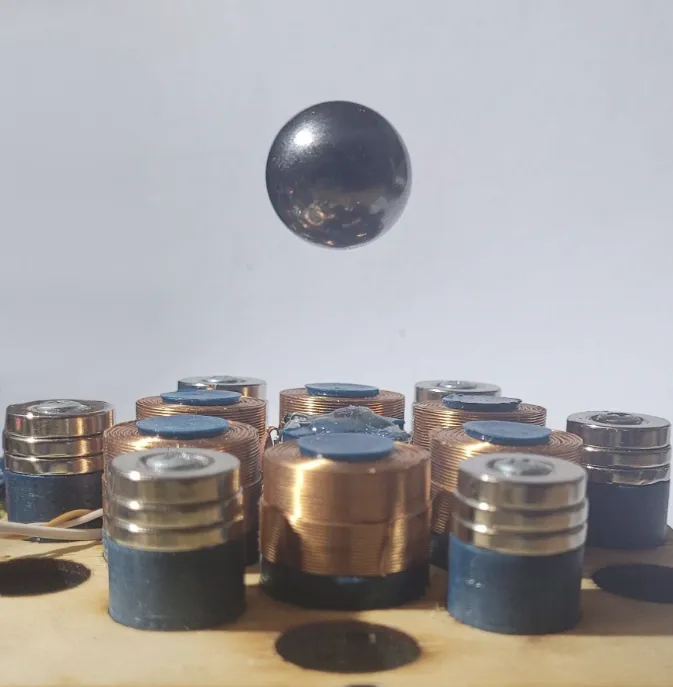
Designed and built a magnetic levitation platform that actively controls elevation and rotation without external camera arrays. The system relies entirely on base-integrated Hall sensors.
Technical Highlights
- Hardware & Sensing: Performed characterisation of Hall sensors, permanent magnets and active coils. Customized electromagnets and H-bridge drivers for precise control of magnetic fields with high frequency and low hysteresis.
- Real-Time Interference Cancellation: Modelled and implemented IIR filter to neutralize electromagnetic interference from active coils to get clear reading from the hall sensors.
- Sensor configuration: Created custom sensor board with differential amplifiers to linearize and amplify the Hall sensor signals.
- Firmware Optimization: Rewrote low-level STM32 HAL routines on an ARM Cortex-M4, cutting ADC sampling latency from to , allowing for a control loop frequency.
- Modeling & Control: Derived transfer functions from COMSOL 3D FEM modeling of the magnetic fields. Decomposed multiple-input-multiple-output system into separate axes, and implemented closed-loop PD control for position with theoretically analyzed stability.
Technical parameters
- Hardware: STM32F411RE (100 MHz) | 4–6 Electromagnets | DRV8874 Drivers (64 kHz PWM)
- Arrangement: Experimented with arrangements of 4 or 6 electromagnets and permanent magnets to vary the levitation stability and payload capacity.
- Capabilities: up to 200 g of leviated payload | active height adjustment range | Automatic equilibrium calibration